

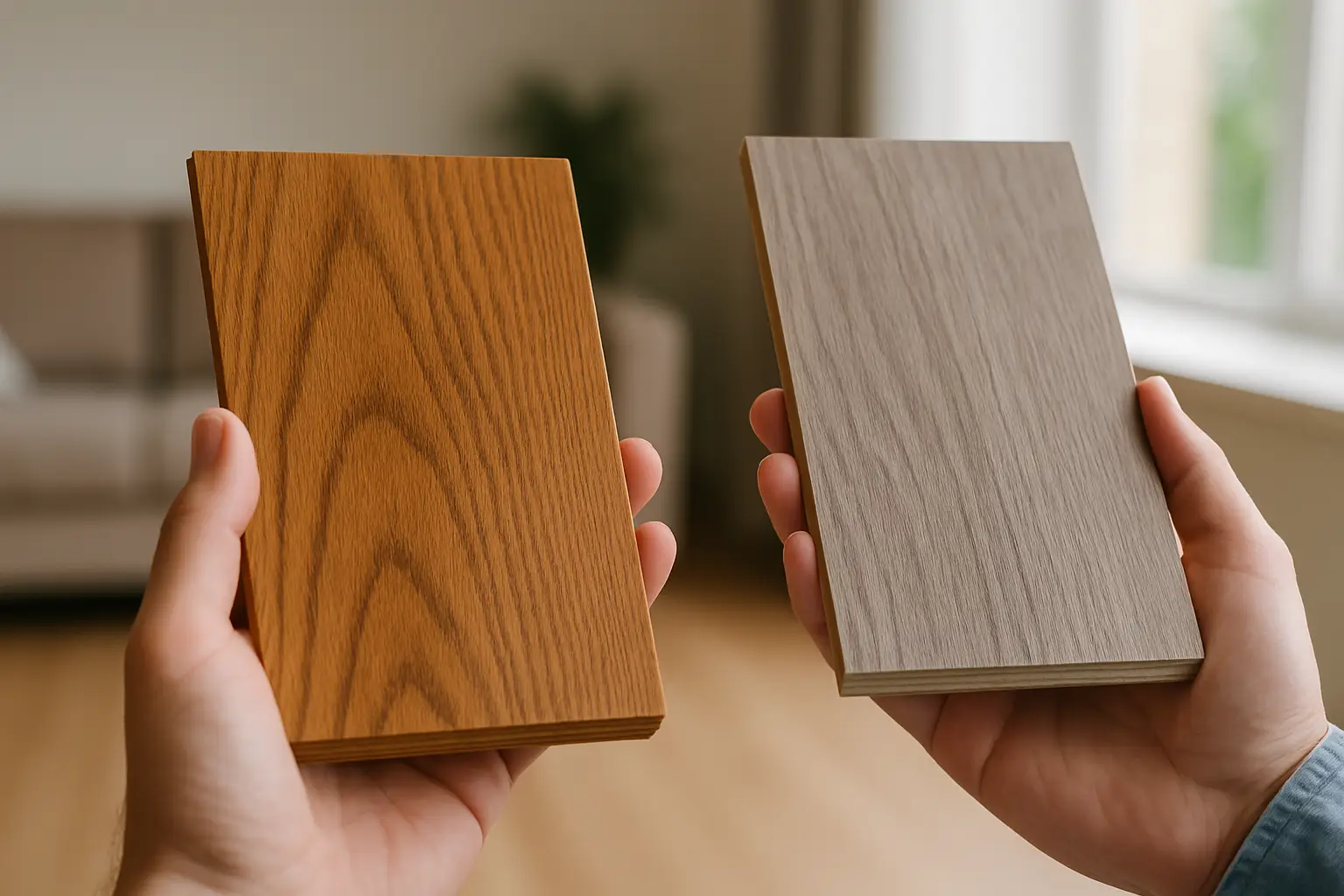
You can usually tell which floor was a rushed decision within about six months – it starts with a few edge chips near the pantry, a squeak line in the hallway, or a “why does this feel hollow?” moment underfoot. Flooring is the most used finish in your home, and in the Meridian-Boise-Nampa corridor it also has to handle real life: grit from the yard, wet boots in winter, and big temperature swings between seasons.
If you’re weighing hardwood vs laminate flooring, you’re already asking the right question. Both can look sharp. Both can be installed well or poorly. The difference is how they behave after the installers leave – and what kind of ownership experience you want for the next 10 to 25 years.
Hardwood vs laminate flooring: the real difference
Hardwood is a real wood wear surface. Depending on the product, that might be solid hardwood (one piece of wood) or engineered hardwood (a real hardwood top layer over a stable core). Either way, you’re walking on real wood grain.
Laminate is a layered product with a photographic “wood look” layer under a clear wear layer, bonded to a dense core and backing. Quality laminate can look surprisingly convincing, but it is still a printed surface designed to resist wear rather than be refinished.
That single distinction drives most of the trade-offs: hardwood can be refinished and repaired more traditionally, while laminate is built to take day-to-day abuse and then be replaced when its surface is done.
Cost and value: upfront price vs long-term payoff
Most homeowners start with budget, and it’s a practical place to begin. Laminate generally has a lower material cost, and installation can be straightforward when the subfloor is flat and transitions are simple.
Hardwood typically costs more for both material and installation. Solid hardwood often requires more acclimation, fastening, and attention to subfloor conditions. Engineered hardwood can be more flexible, but it’s still a premium finish.
Where it gets nuanced is value. Hardwood tends to carry stronger resale perception because it’s a traditional, “real” finish. Laminate can still show well in listings, but buyers may treat it as a shorter-life surface. If you plan to stay in the home a long time, the better question is not “Which is cheaper?” but “Which will I be happiest maintaining?”
Durability: dents, scratches, and daily traffic
If you have kids, dogs, or a steady stream of guests, durability matters more than a showroom look.
Laminate is often the better scratch-resistance play. The wear layer is designed for abrasion, which is why it performs well in busy living rooms and hallways. That said, laminate can chip at edges if it’s hit hard, and once the surface is damaged you can’t sand it down to erase the problem.
Hardwood can scratch more easily, especially darker stains that show contrast. It can also dent from dropped pans or heavy furniture. The upside is repairability: many scratches can be screened and recoated, and some floors can be sanded and refinished to reset the whole surface. With engineered hardwood, how many refinishes you get depends on the thickness of the real wood top layer.
A detail most people miss: floor protection habits matter as much as the product. Felt pads, mats at entries, and keeping grit out of the home will dramatically extend the life of either option.
Water and moisture: where each floor gets risky
Moisture is where the hardwood vs laminate flooring decision can make or break a project.
Hardwood does not like standing water. Spills happen, but puddles that sit, pet accidents that go unnoticed, or repeated wet-mopping can cause swelling, cupping, or staining. Engineered hardwood is generally more dimensionally stable than solid, which helps, but it’s still wood.
Laminate’s weakness is water at the seams and edges. Many newer laminates advertise improved water resistance, and some perform well against short-term spills. But if water gets into the core, swelling can be permanent and seams can telegraph. In kitchens, powder baths, and entry areas, product selection and installation details matter a lot.
If you’re flooring a bathroom, neither traditional hardwood nor standard laminate is the first choice we’d recommend. Bathrooms demand a surface designed for frequent moisture exposure, and that’s usually where tile or a waterproof floating product makes more sense. If you want a wood look in a bath, plan the whole system: underlayment, perimeter sealing, toilet flange height, and transitions.
Look and feel: what you notice every day
Hardwood has a depth and variation that’s hard to copy. It also tends to feel more solid underfoot, especially when installed over a well-prepped subfloor with the right fastening method. If you love natural character – grain movement, subtle color change over time – hardwood delivers.
Laminate has come a long way visually. Wider planks, better embossing, and more realistic patterns mean it can look great in photos and in person. Where laminate sometimes gives itself away is sound and feel. A floating floor can sound “clicky” if the subfloor isn’t flat, the underlayment is wrong, or the product is thin. Those are installation and product-quality issues, not inevitable flaws, but they are common.
If you’re sensitive to noise, talk through underlayment options and subfloor prep before you buy. A floor that looks perfect but sounds hollow will get old quickly.
Installation and project risk: what makes floors fail
Most flooring complaints come back to prep and sequencing, not the plank itself.
Hardwood demands proper acclimation and moisture testing. If you install too soon, seasonal movement can create gaps, buckling, or squeaks. It also requires clean transitions at stairs, fireplaces, and doorways. That’s craftsmanship work – the “pretty” details everyone sees.
Laminate requires a flat subfloor and correct expansion gaps. If the floor is out of plane, you can get separation, bounce, or joint failure over time. Cabinets and heavy islands are another planning point: some floating floors shouldn’t be trapped under fixed cabinetry, so kitchen remodels need coordination.
In either case, the biggest risk is rushing the prep to save a day. A level, sound subfloor and clean layout lines are not optional if you want a professional result.
Maintenance and repairs: what you’ll actually live with
Hardwood maintenance is straightforward: dry dusting, damp (not wet) cleaning with the right product, and fast cleanup of spills. The payoff is that you can restore the finish later. If you’re the type of homeowner who likes to refresh and improve over time, hardwood fits that mindset.
Laminate maintenance is also easy: regular vacuuming and light damp cleaning. The difference is repair strategy. A damaged laminate plank is typically replaced, not refinished. That can be simple if you have extra material and the layout allows for it, or it can be more involved if the damage is in the middle of the room.
A practical tip either way: buy extra flooring from the same dye lot and store it flat in a dry space. It’s inexpensive insurance for future repairs.
Which rooms in an Idaho home suit each option?
For living rooms, dining rooms, and hallways, both hardwood and laminate can perform well. If you want long-term value and a classic feel, hardwood is hard to beat. If you want high traffic resistance with a controlled budget, laminate is often a smart choice.
For kitchens, it depends on how you cook and live. If you’re diligent about wiping spills and you want a cohesive “real wood” look through the main level, engineered hardwood can work well. If your kitchen sees constant activity, pets, or frequent splashes, laminate with strong water resistance can be a more forgiving surface, as long as the installation is detailed correctly at edges and appliances.
For basements, pay attention to slab moisture. Many basements in our area are better candidates for laminate or engineered hardwood designed for below-grade use, paired with the right underlayment and moisture control. Solid hardwood is usually the riskiest option below grade.
For entryways and mudrooms, durability and moisture matter more than romance. If you’re committed to a wood look there, choose the product with that reality in mind and plan for mats, runners, and a transition that protects edges.
How to decide without overthinking it
A good decision usually comes down to three honest questions. First: are you choosing a floor you want to refinish someday, or a floor you want to replace when it’s tired? Second: what is the worst moisture event this floor will see – not the average day, the worst day? Third: are you willing to invest in prep and detail work, or are you trying to keep the project simple and contained?
If you want a premium, long-term finish and you like the idea of renewing it later, hardwood is the better fit. If you want a durable, cost-conscious surface that holds up to daily wear with minimal fuss, laminate can be the practical win.
When you’re ready to move from “product research” to a floor that actually performs, the installation plan matters as much as the material selection. My Contractor LLC helps homeowners across Meridian, Boise, and Nampa choose the right floor for the room, the subfloor, and the way the home is used – then installs it with the detail work that keeps it looking clean for years.
A helpful way to end the debate is to bring home a few large samples, set them in the rooms you’re flooring, and live with them for a couple of days. Morning light, evening light, and the sound under your feet will make the decision for you faster than any showroom conversation.