

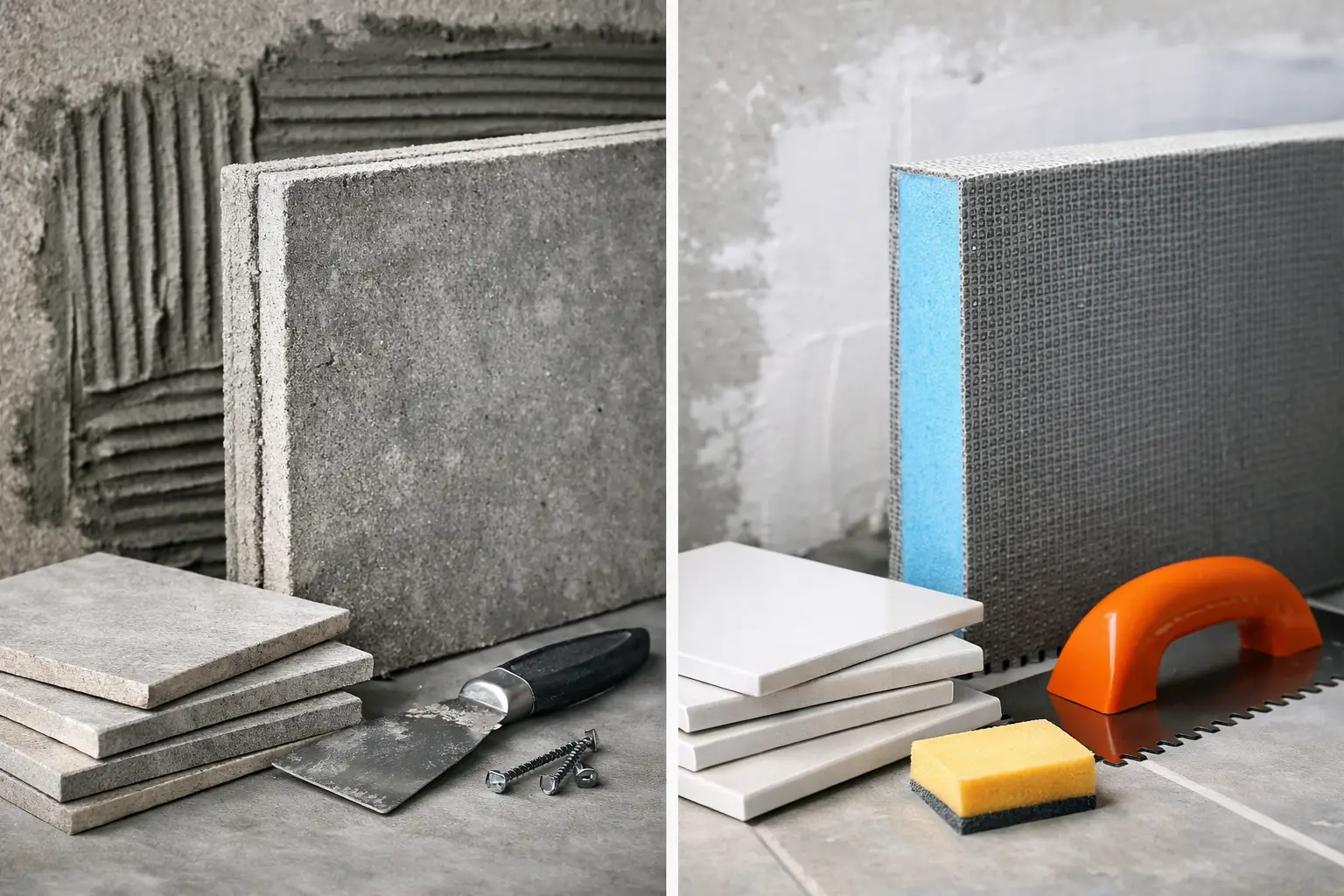
If you’re planning a bathroom remodel, the cement board vs foam board decision matters more than most homeowners expect. Once tile goes up, the board behind it is hidden – but it has a major impact on moisture control, installation quality, long-term durability, and labor cost. Choosing the right one is less about hype and more about where it’s going, what finish you want, and how the project is being built.
In our experience, this choice comes up most often in shower surrounds, tub surrounds, bathroom walls, and occasionally floors. Both materials can be part of a high-quality tile installation. The difference is that they solve different problems, and one is not automatically better in every situation.
Cement board vs foam board: the real difference
Cement board is a dense, rigid backer made from cementitious material reinforced with mesh or fibers. It has been a standard choice in tile work for years because it provides a stable surface that resists moisture damage better than drywall or wood-based panels. It is not harmed by water the way drywall is, but that does not mean it is waterproof.
Foam board is a lightweight tile backer panel with a foam core and a waterproof facing. It is designed to create a tile-ready substrate while also serving as part of the waterproofing system when seams and fasteners are treated correctly. That built-in waterproofing is one of the biggest reasons it has become popular in modern shower construction.
So when homeowners ask which is better, the honest answer is this: cement board is proven, solid, and often more budget-friendly on material cost, while foam board is lighter, faster to install, and better suited to projects where integrated waterproofing and precision matter.
Where cement board makes sense
Cement board still earns its place on many remodeling projects. It is durable, familiar to experienced installers, and well-suited for tile walls and some floor applications when installed correctly over the proper substrate. If the project already includes a separate waterproofing method, cement board can perform very well.
That said, it comes with more steps. In a shower, cement board needs a full waterproofing system over it or behind it, depending on the assembly being used. If that step is skipped or handled carelessly, moisture problems can follow. The board itself may not fall apart quickly, but water can still reach framing, insulation, and adjacent materials.
It is also heavier and messier to work with. Cutting it creates dust, moving it takes more effort, and fastening it can be slower. On a simple job that may be manageable. On a detailed bathroom renovation with niches, benches, custom layout lines, and multiple transitions, the labor side starts to matter.
Where foam board stands out
Foam board is especially strong in shower builds and other wet areas where waterproofing cannot be treated as an afterthought. Because the panel itself is waterproof, the installer is mainly focused on sealing seams, corners, penetrations, and fasteners according to the manufacturer’s system. That can create a cleaner, more controlled assembly.
It is also much easier to cut and shape. That matters when the design includes recessed niches, curbless shower transitions, built-in benches, or walls that need correction before tile goes on. Foam board can help a skilled tile contractor move faster without giving up finish quality.
Another advantage is weight. Carrying foam board upstairs, fitting it in tight bathrooms, and adjusting panels on site is simply easier. For homeowners, that may sound minor, but lighter materials can reduce handling issues and help keep the installation process cleaner and more efficient.
The trade-off is cost. Foam board materials usually cost more upfront than cement board. If you’re comparing price tags only, cement board often looks like the value choice. But if foam board saves labor and reduces waterproofing steps, the total installed cost may be closer than it first appears.
Waterproofing is where most decisions are won or lost
For bathroom remodels, especially showers, waterproofing is usually the deciding factor in the cement board vs foam board conversation. Cement board is water-resistant in the sense that it can handle moisture exposure better than drywall, but it is not a waterproof barrier. Water can pass through it, and that is why a proper membrane or waterproofing layer is required.
Foam board is designed to be part of that barrier from the start. When installed as a complete system, it can reduce the number of failure points. That does not make it foolproof. Poor seam treatment, rushed fastener sealing, and sloppy transitions can still cause problems. But the system is built with waterproofing in mind from the beginning, which is a real advantage in showers.
For homeowners, the key point is simple: neither board makes up for bad workmanship. A well-installed cement board system will outperform a badly installed foam board system every time. The installer, the details, and the sequencing matter as much as the product selection.
Strength, durability, and tile support
A common concern is whether foam board feels less substantial than cement board. That’s understandable. Cement board feels hard and heavy, which gives people confidence. Foam board feels lighter, and to some homeowners that can sound less durable.
In practice, both can support tile successfully when installed according to manufacturer requirements and over proper framing. The real issue is not whether the board feels heavy in your hands. It is whether the wall assembly is flat, well-fastened, properly waterproofed, and suitable for the tile size and load.
For standard ceramic and porcelain tile in bathrooms, either system can work. For more demanding conditions, such as very large format tile, irregular framing, or specialty assemblies, product selection and installation details matter more. This is where experience counts. The right answer depends on the wall condition, framing spacing, tile choice, and overall design.
Cost: material price versus installed value
Homeowners often ask which one saves money. The honest answer is that cement board usually wins on raw material price, while foam board may win on labor efficiency. If you’re looking only at a board stack in a store, cement board typically appears cheaper.
But bathroom remodeling is not a material-only decision. Labor, waterproofing products, waste, cleanup, cutting time, and installation complexity all affect the final number. Foam board may carry a higher product cost, yet shorten install time and reduce some of the extra waterproofing steps. In a detailed shower remodel, that can narrow the gap.
This is why quote comparisons need context. A lower number does not always mean the same assembly is being built behind the tile. Ask what waterproofing method is included, how corners and penetrations are treated, and whether the system is appropriate for the wet area involved.
Cement board vs foam board in Idaho bathrooms
In the Meridian, Boise, and Nampa area, homeowners are often remodeling older bathrooms with dated materials, uneven walls, and moisture issues that have built up over time. In those settings, board choice should support both performance and finish quality. If the wall framing is out of plane or the shower design includes custom details, foam board can offer practical advantages. If the project calls for a straightforward, proven assembly with a properly applied membrane, cement board can still be the right fit.
What matters most is that the system matches the project. A guest bath with a basic tub surround may not need the same approach as a primary suite shower with niches, heavy glass, and high-end tile. Treating every bathroom the same is where shortcuts begin.
Which should you choose?
If your priority is a time-tested substrate and lower material cost, cement board may be the better fit – provided the waterproofing plan is solid and professionally executed. If your priority is integrated waterproofing, cleaner installation, and a more efficient build in a wet area, foam board often has the edge.
For many shower remodels, especially custom showers, foam board is hard to ignore because it simplifies one of the most critical parts of the job. For some walls and floor applications, cement board still makes excellent sense. This is not about picking a winner for every project. It is about choosing the system that supports a durable tile installation and a bathroom you won’t have to second-guess later.
At My Contractor LLC, we look at these decisions the same way we approach the rest of a remodel – with precision, clear guidance, and attention to what will hold up in the real world, not just what sounds good on paper.
The best board is the one that fits your shower, your tile plan, and your budget without cutting corners where moisture protection matters most.