

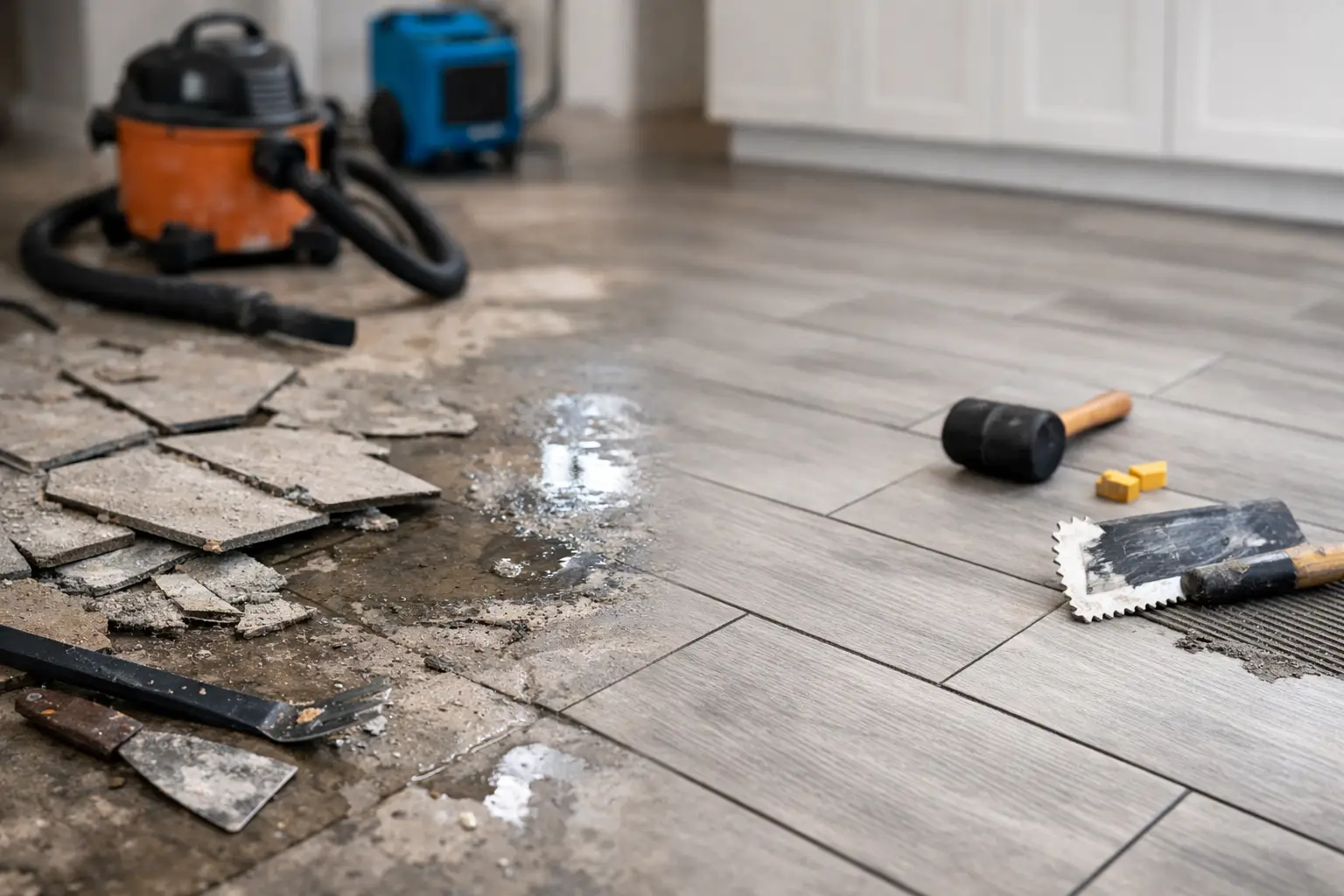
A wet tile floor can fool you. The surface may still look solid, but if water has worked its way under the tile, into the underlayment, or along the wall base, the real damage is usually hidden. That is why a tile floor replacement after water damage example matters – it shows what homeowners are actually dealing with, not just what they can see from the top.
In homes around Meridian, Boise, and Nampa, this often starts with something small. A leaking toilet seal, a slow dishwasher line, a failed shower curb, or an appliance overflow leaves enough moisture behind to weaken the floor system over time. By the time a tile sounds hollow or grout starts cracking, the problem has often moved beyond a simple repair.
A real-world tile floor replacement after water damage example
Picture a main-floor bathroom where the homeowner noticed loose grout near the toilet and a slight soft spot just outside the shower. The tile was older, the bathroom had been remodeled years earlier, and nothing looked dramatic at first glance. But the wax ring under the toilet had been leaking slowly, and shower splash had been getting past a failed caulk joint for months.
Once demolition started, the cause became clear. Several tiles released with very little effort because the bond had failed. The cement backer board underneath was darkened and brittle in sections. The subfloor near the toilet flange had swollen, and the edge near the shower entry showed signs of repeated moisture exposure. Along the vanity wall, the base trim had absorbed water and started to break down on the back side.
At that point, trying to save a few tiles would have been the wrong decision. The damaged layers had to be removed fully so the floor could be rebuilt on a sound, dry base. That is where a lot of homeowners shift from thinking they need a tile fix to understanding they need a flooring system replacement.
What had to be replaced and why
In this example, the finished tile was only one part of the assembly. The contractor removed the tile, thinset residue, backer board, and the compromised subfloor sections. The toilet was pulled, the flange area was cleaned up, and the moisture-affected trim and part of the drywall base were replaced as well.
This is one of the biggest misunderstandings with water damage. Tile itself is not always the failure point. Water can move through grout joints, around plumbing penetrations, and under wall edges. If the substrate loses integrity, the new floor will not perform well, even if the replacement tile is high quality and professionally installed.
Drying and verification matter just as much as demolition. Before rebuilding, the framing and surrounding materials need to reach acceptable moisture levels. Rushing this step can trap moisture and lead to odor, movement, or mold-related issues later.
The rebuild process
After damaged materials were removed and the area was properly dried, the subfloor was patched and reinforced where needed. A new tile-ready underlayment was installed, the floor was flattened, and waterproofing details were addressed around the toilet area and shower-adjacent section. Then came the finish work – layout, tile installation, grout, trim, reset of fixtures, and final sealing where appropriate.
That sequence is what separates a cosmetic patch from a durable repair. Precision matters at every stage, because tile is unforgiving. If the base is uneven, weak, or still damp, the finished floor may look fine for a month and then start failing again.
When repair is enough and when full replacement makes more sense
Not every wet floor needs complete replacement. If the water event was caught quickly, the affected area is small, and the substrate is still sound, a targeted repair may be possible. That usually depends on whether matching tile is available and whether the moisture stayed at the surface.
Full replacement makes more sense when tiles are loose across a broad area, the floor feels soft, grout cracking keeps returning, or there is visible swelling in the subfloor. It is also the smarter route when the tile is discontinued and spot repairs would leave a patched appearance in a visible room.
For many homeowners, this becomes both a restoration decision and a value decision. If you are already opening the floor, it may be the right time to improve the layout, update the tile style, or address aging fixtures in the same project. That approach can be more efficient than repairing damage now and planning a remodel a year later.
Warning signs homeowners should not ignore
A tile floor rarely announces water damage all at once. More often, it gives smaller signs first. Hollow-sounding tile, cracked grout that reappears after repair, a musty smell, loose base trim, or a slight rise around the toilet are all worth attention.
You may also notice tile edges lifting near a tub, shower, exterior door, or laundry area. In some cases, the grout looks stained even after cleaning because moisture is working up from below. If the floor feels colder or damper in one section, that can also point to trapped moisture.
The trade-off is that some of these symptoms can come from installation failure rather than water. Poor thinset coverage, movement in the subfloor, or wrong underlayment can create similar surface issues. That is why a proper inspection matters. The goal is not just to replace what looks bad, but to identify why it failed.
What affects cost in a water-damaged tile floor project
Homeowners usually ask for a ballpark number first, and that is understandable. The honest answer is that water-damaged tile replacement depends heavily on what is underneath. A small bathroom with limited subfloor damage is very different from a kitchen where cabinets, toe kicks, and a large flooring field are involved.
The main cost drivers are the size of the affected area, how much demolition is needed, whether plumbing fixtures must be removed and reset, and whether subfloor or wall repairs are required. Material selection matters too. Standard ceramic tile and straightforward layouts cost less than large-format porcelain, patterned installations, or specialty trim details.
Access and project coordination also affect pricing. If permits, inspections, or multiple trades are needed, that changes the scope. A licensed contractor who manages the work from demolition through finish installation can keep that process cleaner and more accountable, which is often worth it for homeowners who do not want to coordinate several moving parts themselves.
Why the replacement method matters as much as the new tile
A tile floor is only as good as the system below it. That includes the framing stiffness, subfloor condition, underlayment choice, waterproofing details, and installation quality. If any one of those is handled casually, the floor may not hold up, especially in bathrooms, laundry rooms, mudrooms, and kitchens where moisture exposure is common.
This is where craftsmanship shows. Clean demolition avoids unnecessary damage. Proper moisture evaluation prevents rebuilding too soon. Careful prep creates a flat, stable surface. Thoughtful tile layout improves both appearance and longevity, especially around doorways, vanities, and transitions.
For homeowners who value a done-right result, that process matters more than chasing the cheapest number. Water damage is one of those areas where shortcuts often stay hidden until the floor starts failing again.
Choosing the right next step after water damage
If your floor has already shown signs of movement or moisture, waiting usually makes the repair broader, not smaller. The practical next step is to have the affected area assessed with a focus on both visible finish damage and hidden substrate damage. In many cases, a contractor can tell fairly quickly whether the issue is surface-level or whether replacement is the safer investment.
For property owners in the Treasure Valley, working with a licensed, detail-oriented team like My Contractor LLC can make the process far less stressful. When tile work, floor prep, fixture coordination, and code-conscious repair are handled under one roof, homeowners get clearer answers and a cleaner path forward.
A good floor should feel solid underfoot, look clean at every edge, and stay that way. After water damage, the right fix is not just about replacing tile. It is about restoring confidence in the space you use every day.