

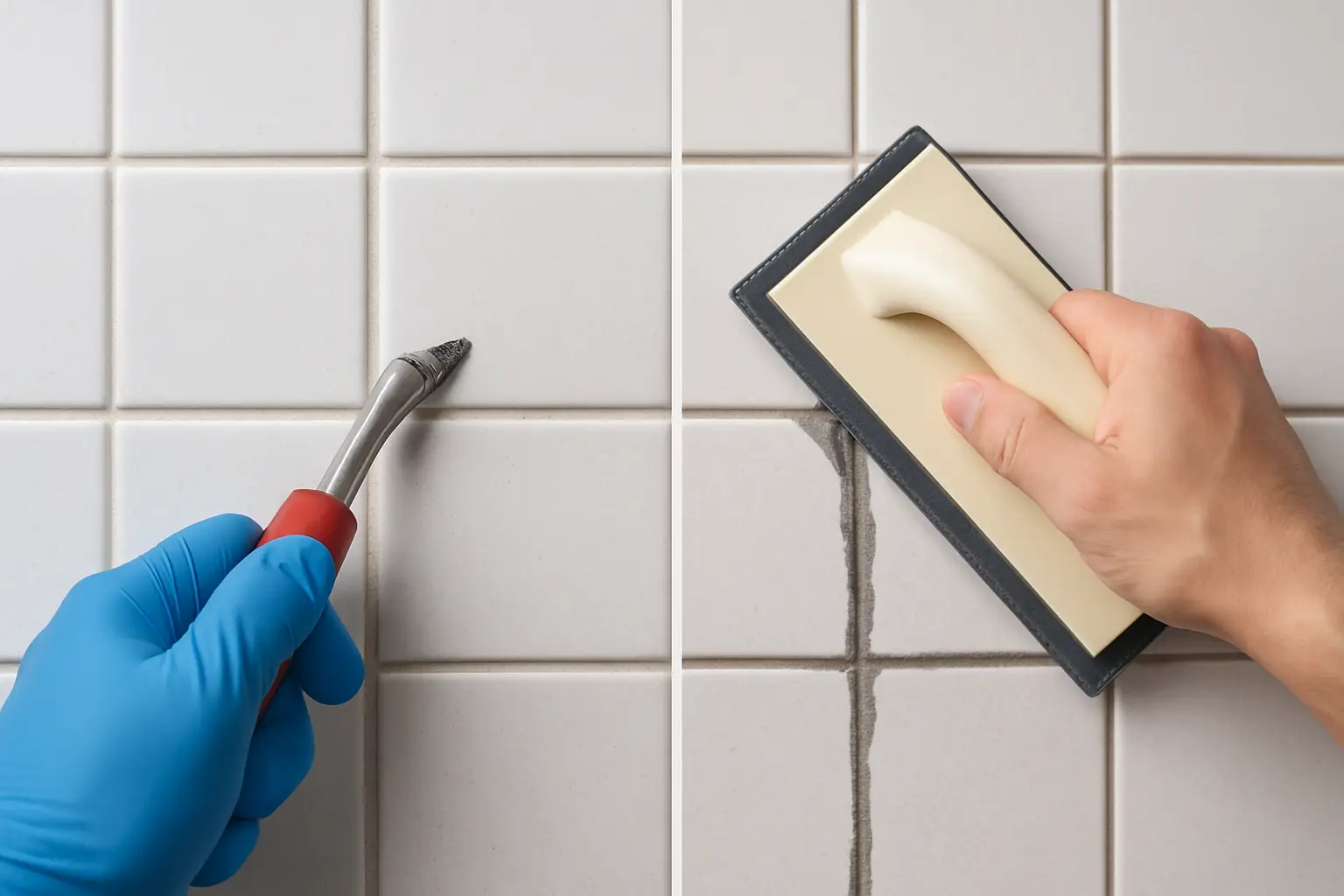
You can usually spot grout trouble from the doorway: a hairline crack tracking along the shower corner, a dark strip that never looks clean, or a few joints that feel sandy when you run a finger over them. The big question is not whether it looks bad – it’s whether you’re dealing with a small, local problem or a system that’s starting to fail.
That’s where the decision between grout repair vs regrout matters. One option is targeted and conservative. The other is a reset that can protect the tile installation for years. If you choose the wrong one, you’ll either spend money you didn’t need to spend or keep patching the same spots every few months.
Grout repair vs regrout: what each actually means
Grout repair is a localized fix. A few cracked joints get removed and replaced, small voids get filled, and problem areas get cleaned up so water and grime stop collecting. It’s typically the right move when the tile is solid, the grout around the issue is still bonded, and you’re not seeing broader symptoms.
Regrouting is a larger-scope approach. It usually means removing grout across a substantial area – sometimes an entire shower, tub surround, or bathroom floor – and installing new grout consistently throughout. Regrouting is often chosen to fix widespread cracking, persistent discoloration that won’t respond to cleaning, failing grout that powders out, or uneven joints that were never installed correctly.
Here’s the part many homeowners miss: neither option is a substitute for fixing what’s underneath. If the tile assembly is moving, if water is getting behind the tile, or if the substrate is compromised, new grout will not last. Good work starts with diagnosing why the grout failed.
When grout repair makes sense
Grout repair is worth considering when the failure is limited and the rest of the installation is performing the way it should. In the Treasure Valley, we often see “normal wear” issues in showers that get heavy daily use, especially when cleaning habits or hard water contribute to buildup.
A repair is usually a solid choice if the cracking is confined to a few joints, especially in low-stress areas, and the surrounding grout is still hard and intact. Another common repair scenario is small gaps that appeared at a change of plane – like where the wall meets the floor or where two walls meet. (In many showers, those corners should be caulked with a color-matched, flexible sealant rather than grouted, because corners move.)
Repairs also make sense when you’re trying to extend the life of an otherwise good bathroom ahead of a larger remodel. If you know you’re renovating in a year or two, a targeted repair can keep things clean, safer, and more water-resistant without over-investing.
The trade-off is longevity. A repair is only as good as the surrounding grout and the stability of the tile assembly. If the installation has multiple weak points, repairs can turn into a cycle.
When regrouting is the smarter move
Regrouting becomes the better call when grout problems are not isolated. If you’re seeing cracks in multiple locations, joints that crumble when scrubbed, or widespread staining that returns quickly after cleaning, the issue is usually bigger than a patch.
A full regrout can also be the right move when the bathroom looks tired even though the tile is still in great shape. Fresh grout lines change the whole feel of a shower or floor because grout frames every tile. If the tile layout is strong and you like the style, regrouting can be the refresh that gets you back to “like new” without full tile replacement.
It’s also a practical choice when the original grout was installed poorly: inconsistent joint depth, pinholes, shallow pack, or too much water used during cleanup. Those issues don’t always show up immediately, but they can cause premature cracking and staining.
The trade-off with regrouting is disruption and cost. It takes more labor and it can create more dust because grout removal is real demolition work. The upside is consistency: the entire surface gets treated as one system rather than a series of spot fixes.
The real decision point: what’s causing the grout to fail?
Grout is not a waterproofing layer. It is a wear surface and a filler between tiles. In showers especially, the waterproofing should be behind the tile. When grout fails, it can be because of normal age, but it can also be a symptom of movement or moisture problems.
If you notice tiles that sound hollow, feel loose, or shift underfoot, grout repair is rarely the answer. That usually points to tile bond failure, substrate movement, or moisture damage below. Likewise, if there’s persistent damp smell, soft drywall adjacent to the shower, swelling baseboards, or staining outside the wet area, you need a deeper evaluation before choosing any grout work.
Even smaller clues matter. Cracks that reappear in the same spot often indicate movement: a floor with deflection, a transition between materials, or a change of plane that needs flexible sealant instead of grout. A good contractor will look at where the cracking occurs, not just that it occurs.
Cost and timeline: what to expect
In most homes, grout repair is faster and less expensive because it targets a limited area. It can sometimes be completed in a single visit with minimal downtime, depending on drying and curing time.
Regrouting takes longer because removal and prep are the bulk of the work. Expect multiple steps: protecting surfaces, removing grout to an appropriate depth, cleaning joints thoroughly, installing grout evenly, and then curing it properly. In showers, you also need a realistic plan for downtime, because grout should cure before being exposed to water.
If you’re comparing quotes, be careful about “too fast” promises. Rushing the removal, leaving dust in the joints, or grouting over compromised material is how you pay twice. The price difference between repair and regrout only matters if the work actually holds.
Color matching, sealing, and why some grout always looks dirty
One reason homeowners lean toward regrouting is aesthetics. That’s valid. Grout lines collect soap residue, minerals, and body oils. In many Boise and Meridian-area homes, hard water makes this worse, especially in showers with heavy use.
With repairs, color matching can be challenging. Even if you use the same grout brand and color, the existing grout may have aged, absorbed minerals, or been affected by cleaners. A repaired section can stand out.
With regrouting, you get uniform color and texture – but only if the right grout is selected and mixed correctly. Some grout types are more stain-resistant than others, and some perform better in wet areas. Sealing can help with certain cement-based grouts, but it’s not a magic shield. If the shower isn’t cleaned regularly and ventilated well, even sealed grout can discolor.
A practical approach is to pair good grout work with habits that protect it: consistent ventilation, a quick rinse or squeegee after showers, and avoiding harsh cleaners that degrade grout over time.
DIY vs hiring a pro: the honest line
Small grout repairs are one of the more approachable DIY tasks – if the issue is truly minor and you’re willing to be patient. The common DIY failure is not the grouting itself, it’s the prep. If you don’t remove enough of the old grout, if you leave dusty joints, or if you repair over a moving corner that should be caulked, the fix won’t last.
Regrouting a full shower or bathroom floor is more demanding. Dust control matters. Joint depth matters. Consistent packing and cleanup matter. And if you nick tile edges during removal, you can turn a grout project into a tile replacement project.
If you want a result that looks sharp, cures correctly, and holds up, it’s worth bringing in a contractor who treats tile work like finish carpentry – with precision and attention to detail – rather than a quick patch job.
How we help homeowners in Meridian, Boise, and Nampa
When homeowners ask us to weigh grout repair vs regrout, we start by checking stability and moisture risk, then we talk through your goal. Is this a short-term cleanup before a remodel? Or are you trying to protect a tile installation you love?
At My Contractor LLC, we approach grout and tile work the same way we approach full bathroom renovations: we look for the “why” behind the problem, then we execute cleanly and on schedule. If a simple repair is all you need, we’ll tell you. If the grout is only the symptom, we’ll be direct about that too.
A few scenarios to help you decide
If your shower has a couple of isolated cracks, the tile feels solid, and the rest of the grout is hard and intact, a targeted repair is usually the practical move.
If your grout is cracking in multiple areas, turning sandy, or constantly discoloring even after cleaning, regrouting is often worth the investment for a more uniform, longer-lasting result.
If tiles are loose, surfaces feel spongy, or you see signs of moisture outside the wet area, pause on grout work and get the installation evaluated. In those cases, repairing grout can hide the real issue while water damage continues.
A bathroom should feel calm and clean, not like a maintenance project you keep chasing. The right choice isn’t the biggest scope – it’s the one that solves the actual problem and respects your home.