

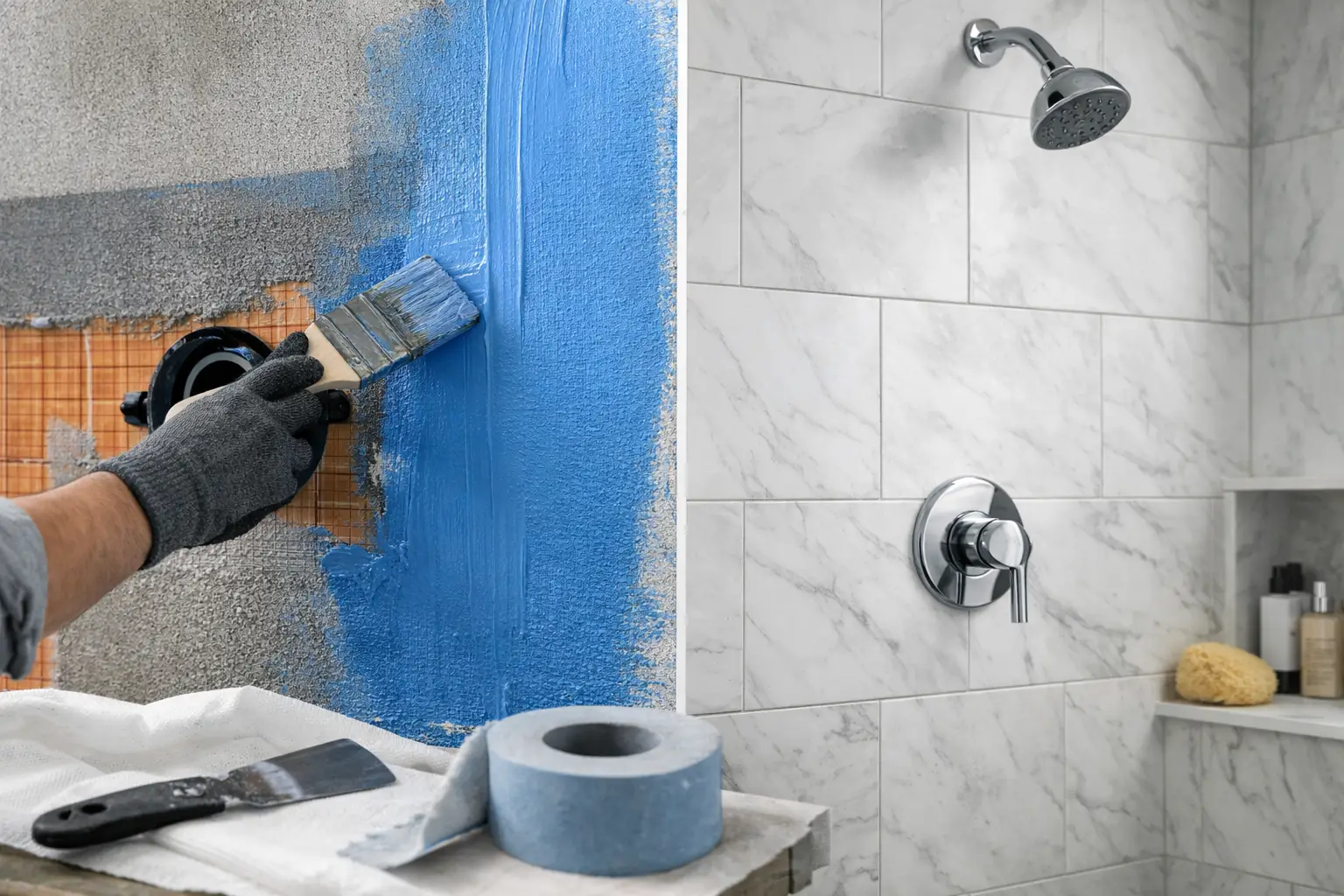
If you’re asking, should I waterproof behind shower tile, the short answer is yes. Tile and grout are not waterproof on their own, and that misunderstanding leads to a lot of shower failures that look beautiful on day one and start causing hidden damage not long after. A well-built shower is not just about straight lines and clean grout joints – it is about what is happening behind the surface.
That matters because shower leaks usually do not announce themselves early. Water can move slowly into backer board, framing, insulation, and subflooring for months before you see a loose tile, swollen trim, or staining on the ceiling below. By the time the problem becomes visible, the repair is often far more expensive than doing the waterproofing correctly from the start.
Why shower tile is not enough
Homeowners are often surprised to learn that tile is a finish surface, not the waterproof layer. Ceramic, porcelain, and natural stone can all resist water to some degree, but the assembly itself still has joints, penetrations, and movement points. Grout is porous, and even sealed grout is water-resistant, not waterproof.
In a shower, that means moisture routinely gets past the tile surface. The real question is not whether water will get behind the tile. It will. The question is whether the wall system behind it is designed to handle that moisture and direct it safely away.
That is why professional shower construction includes a dedicated waterproofing system behind or directly under the tile. Without it, the materials behind the tile become the sacrificial layer, and that is not a durable plan for a high-use bathroom.
Should I waterproof behind shower tile in every shower?
In practical terms, yes – if it is a true shower or tub-shower surround, waterproofing should be part of the build. That includes the walls, corners, niches, benches, and transitions where water collects or repeatedly splashes.
There are a few situations where people get confused. A bathroom wall outside the wet zone may only need standard moisture-resistant treatment depending on layout and code requirements. But inside the shower enclosure, especially around the valve, showerhead wall, and lower wall sections, skipping waterproofing is a gamble with your framing and finishes.
For Idaho homeowners planning a remodel, this is one of those areas where cutting corners rarely saves money. Showers see daily use, seasonal humidity swings, and years of cleaning and wear. If you want a shower that holds up, waterproofing is part of the job, not an upgrade.
What waterproofing actually looks like
When people hear “waterproof behind shower tile,” they sometimes picture a sheet of plastic stapled behind cement board. That was common in older builds, and in some assemblies moisture barriers were used that way. Today, the better approach is usually a complete waterproofing system designed to work with the tile substrate and shower pan together.
There are two main strategies. One uses a moisture barrier behind cement board. The other, and often the preferred modern method, uses a surface-applied waterproof membrane directly over the backer board or foam board, right under the tile.
Surface waterproofing has clear advantages. It keeps water closer to the face of the wall instead of allowing the backer board to absorb and hold moisture. That can help the shower dry more effectively between uses and reduce the chance of mold, deterioration, and musty odors over time.
The details matter as much as the material. Seams need to be treated correctly. Fastener penetrations need to be handled properly. Niches, corners, benches, curbs, and plumbing penetrations need special attention because that is where leaks often start.
The biggest mistakes homeowners should avoid
The most common mistake is assuming cement board is waterproof. It is not. Cement board is durable and moisture-tolerant, but it still needs a waterproofing strategy. If tile is installed directly over cement board in a shower with no membrane and no proper moisture barrier, that assembly is vulnerable.
Another frequent issue is mixing systems incorrectly. For example, installing a vapor or moisture barrier behind the board and then adding a waterproof membrane on the face can create a moisture sandwich, depending on the materials used and the environment. That is not always an automatic failure, but it can trap moisture and create problems. The shower system needs to be built as a coordinated assembly, not pieced together from leftovers or guesswork.
Poorly built niches are another major trouble spot. They look simple from the outside, but they interrupt the wall plane and add multiple inside corners and horizontal surfaces. If they are not carefully waterproofed and sloped, water sits where it should not.
And then there is the shower floor. Even when homeowners ask should I waterproof behind shower tile, they are often focused only on the walls. The pan, curb, drain connection, and floor-to-wall transitions are just as critical. A shower is only as reliable as its weakest point.
When waterproofing matters even more
Some showers need extra care because the risk is higher. Steam showers are one example. They require a different level of moisture and vapor control than a standard shower because warm vapor can move into wall cavities in ways liquid water does not.
Natural stone showers can also demand more planning. Stone may absorb more moisture than porcelain, and some installations stay damp longer. That does not mean stone is a bad choice. It means the substrate and waterproofing have to be done with precision.
Large-format tile creates its own considerations too. Fewer grout joints can be good for maintenance, but flatter walls and a very consistent substrate become more important. If the assembly behind the tile is not properly prepared and waterproofed, the premium finish on the surface will not save it.
Second-floor bathrooms deserve attention as well. A leak in an upstairs shower can affect ceilings, insulation, electrical work, and flooring below. The hidden cost of failure is often much higher than homeowners expect.
How to tell if an existing shower may not be waterproofed
You usually cannot confirm a waterproofing system without opening the wall or having build documentation, but there are warning signs. Persistent mildew that returns quickly after cleaning can suggest the shower is staying wet behind the surface. Loose tiles, cracked grout concentrated in corners, swollen trim outside the shower, soft walls, or staining on adjacent surfaces can all point to moisture intrusion.
Age matters too. Older showers were often built with methods that do not match current best practices. Some held up reasonably well, and others did not. If you are remodeling a dated bathroom, it is smart to assume nothing and inspect the structure once demolition begins.
That is one reason experienced remodelers approach shower rebuilds carefully. A shower can look serviceable from the outside while hiding rot or water damage underneath. Good planning protects the finish work you see and the structure you do not.
Is waterproofing worth the added cost?
Yes, especially when you compare it to the cost of failure. Waterproofing adds labor, materials, and time, but not nearly as much as replacing rotten framing, mold-damaged drywall, or a failed custom shower.
It also protects the investment in everything else you are choosing – tile, fixtures, glass, niches, benches, and trim. Homeowners often focus on visible upgrades because those are exciting decisions. But the work behind the tile is what gives the finished shower real value.
At My Contractor LLC, that is the difference between a shower that only looks high-end and one that is built to perform like it should. Precision is not just about layout and grout lines. It is about building each layer correctly so the finished space lasts.
What to ask your contractor before tile goes in
If you are hiring a professional, ask what waterproofing system they use and why. Ask how they handle corners, niches, benches, and plumbing penetrations. Ask whether the pan and walls are part of one coordinated system. Ask if inspections or flood testing are part of the process where applicable.
A trustworthy contractor should be able to explain the assembly clearly, without hiding behind jargon. You do not need a lecture. You need confidence that the shower is being built with a method that matches the materials, the space, and the long-term use of the bathroom.
This is also where licensing, project management, and attention to detail matter. Shower waterproofing is not the place for vague answers or rushed work. It is one of the best examples of why craftsmanship behind the walls matters just as much as the tile you pick.
If you are planning a shower remodel, treat waterproofing as a standard requirement, not a line item to trim. The tile is the finish. The waterproofing is the protection. When both are done right, you get a shower that looks sharp, performs well, and gives you one less thing to worry about every time the water turns on.
The best bathroom upgrades are the ones you enjoy daily without having to think about what might be going wrong behind the wall.